"We often read of the birth and growth of churches, very rarely of their deaths. In Mosul, however, we may be seeing the end of an astounding example of Christian continuity that lasted nearly two millennia."Full article...
Showing posts with label history. Show all posts
Showing posts with label history. Show all posts
Ancient History
Historian Philip Jenkins on events in Iraq:


Democratic Gospel Theory
"Woodberry's results essentially suggested that 50 years' worth of research on the rise of democracy had overlooked the most important factor."
Read more at CT...
(ht: Douglas Wilson)
Read more at CT...
(ht: Douglas Wilson)
The "Secret" History of Halloween

"We have shown that the modern holiday, while incorporating various elements of recreated ancient paganism, medieval Christianity, early-modern Reformation and nationalism, and Celtic Romanticism, is nevertheless an entirely modern construct, coming into its own in postwar North America. This is our Halloween."Many different theories of the origin of Halloween have been floated through the years, but this article digs further into the real story than any I've seen.
Full article...
Wojtek the Bear

More on Wikipedia...
The Long Now
A remarkable passage from Seneca, doing what he does best (remembering that there are other times and places than here and now). On the question of what comets are and how they move:
Why should we be surprised, then, that comets, so rare a sight in the universe, are not embraced under definite laws, or that their beginning and end are not known, seeing that their return is at long intervals? It is not yet fifteen hundred years since Greece counted the number of the stars and named them every one.
And there are many nations at the present hour who merely know the face of the sky and do not yet understand why the moon is obscured in an eclipse. It is but recently indeed that science brought home to ourselves certain knowledge on the subject. The day will yet come when the progress of research through long ages will reveal to sight the mysteries of nature that are now concealed. A single lifetime, though it were wholly devoted to the study of the sky, does not suffice for the investigation of problems of such complexity. And then we never make a fair division of the few brief years of life as between study and vice. It must, therefore, require long successive ages to unfold all. The day will yet come when posterity will be amazed that we remained ignorant of things that will to them seem so plain.
[...]
Men will some day be able to demonstrate in what regions comets have their paths, why their course is so far removed from the other stars, what is their size and constitution. Let us be satisfied with what we have discovered, and leave a little truth for our descendants to find out.
— L. Annæus Seneca (c. 65 A.D.)
Easter, by the numbers
Jay Ryan from Classical Astronomy gives a good overview of why we celebrate Easter when we do. You'll learn such intricacies as:
[...] every 19 years, the Moon's phases will recur on the same dates of the solar year. This 19 year "luni-solar" cycle was the basis for the calendar used in Babylon. In the west, its discovery is attributed to the Greek philosopher Meton, who may have learned it from the Babylonians. The 19 year cycle was generally well known and understood in antiquity, and was apparently used by the Persian rulers of Babylon after the restoration of Israel.Full article...
Q191: The Scales of War
"Since it is God that turns the scales of war, there is great uncertainty in the issue of battles."
"Kings do not use to requite men for those kindnesses which they received when they were private persons, the height of their fortune making usually no small changes in them."
"With whom is what is righteous, with them is God himself."
"If we allow that this was done by the will of God, we must allow that it is now over by his will also, and that he is satisfied with what hath already happened; for had he been willing to afflict us still more thereby, he had not changed his mind so soon."
"For it is a constant rule, that misfortunes are still laid to the account of those that govern."
— Flavius Josephus, reporting Antipater's advice to his son Herod
~ · ~
"Kings do not use to requite men for those kindnesses which they received when they were private persons, the height of their fortune making usually no small changes in them."
— Josephus
~ · ~
"With whom is what is righteous, with them is God himself."
— Herod, to his men before a battle
~ · ~
"If we allow that this was done by the will of God, we must allow that it is now over by his will also, and that he is satisfied with what hath already happened; for had he been willing to afflict us still more thereby, he had not changed his mind so soon."
— Herod, before battle, encouraging his men not to worry about a recent earthquake
~ · ~
"For it is a constant rule, that misfortunes are still laid to the account of those that govern."
— Josephus
Q190: More Josephus
"[...T]he principal scope that authors ought to aim at above all the rest, is to speak accurately, and to speak truly [...]"
— Flavius Josephus
"[...I]f you now fight manfully you may recover your liberty, which, as it is a
thing of itself agreeable to all men, so it proves to be to us much more
desirable, by its affording us the liberty of worshiping God."
— Josephus, reporting the words of Judas Maccabeus
Stand clear of the elephant
I think there's a moral in here ... somewhere. Josephus on the death of Eleazar Avaran, one of the Maccabees:
"But when his brother Eleazar, whom they called Auran, saw the tallest of all the elephants armed with royal breastplates, and supposed that the king was upon him, he attacked him with great quickness and bravery. He also slew many of those that were about the elephant, and scattered the rest, and then went under the belly of the elephant, and smote him, and slew him; so the elephant fell upon Eleazar, and by his weight crushed him to death. And thus did this man come to his end, when he had first courageously destroyed many of his enemies."
"But when his brother Eleazar, whom they called Auran, saw the tallest of all the elephants armed with royal breastplates, and supposed that the king was upon him, he attacked him with great quickness and bravery. He also slew many of those that were about the elephant, and scattered the rest, and then went under the belly of the elephant, and smote him, and slew him; so the elephant fell upon Eleazar, and by his weight crushed him to death. And thus did this man come to his end, when he had first courageously destroyed many of his enemies."
— Josephus, Antiquities of the Jews 12.9.4
So, it isn't funny (I keep telling myself that. Well ... maybe it's a little bit funny.). Eleazar died a heroic death and it was seen as such at the time. I take away something sort of like "pride goeth before a fall", but not in a negative sense. Eleazar's victory was genuine — he was doing exactly what he should have been doing; it's just that the very fact of that victory opened him up to defeat.
Have you noticed how often this is the case? Just when you are on top of the world, that's when trouble comes along. And not just that: the trouble would have passed you by and left you alone if you hadn't let your guard down because of your success. From now on, I'll say to myself in that situation: "make sure to stand clear of the elephant".
Q188: Josephus
I'm reading through Josephus's Antiquities of the Jews. Some bits I came across:
"[I]nnocence is the strongest army."
"[I]nnocence is the strongest army."
— Flavius Josephus
— · —
"Your bodies are mortal, and subject to fate, but they receive a sort of immortality, by the remembrance of what actions they have done."
— Josephus, reporting the words of Mattathias (father of the Maccabees)
Mechanical computers
I was aware that, before electronic computers, they used to use mechanical computers to automate hard math problems, such as fire control for warships. Seeing this set of videos, however, really made me appreciate how unbelievably clever some of these mechanisms were.
Swartz: "How we stopped SOPA"
Aaron Swartz (1986-2013) — one of the names behind the movement to stop the SOPA legislation last year — remembers that campaign:
Christian fiction for the 10th century
Douglas Wilson on how it is possible to see Beowulf as a kind of Christian apologetic:
Read the complete essay here...
"Hrothgar does not fight, and he cannot save the people. Beowulf does fight, successfully—and the ultimate point of the poem is (as we will see) that he cannot save the people from this cycle of violence either. Not fighting does no good, but neither does fighting.
[...] This is where the poem brings us, only to abandon us there. What can be done to save this people from their lost condition? By the end of the poem, it is absolutely certain that there is nothing that the people of this culture can do themselves about their lostness."
Read the complete essay here...
Q170: The White Horse
"[...] hasty and ad hoc decrees that addressed immediate national problems without taking the time to reflect on and consider the eternal principles of justice were fated to end in villainy and abuse. Only those laws that had been founded on the eternal principles of justice, had stood the test of time, had been passed on from generation to generation, and had received the approval of the wisest counsellors should be enacted and enforced by a just king."
— Ben Merkle
— and —
"And though skies alter and empires melt,
This word shall still be true:
If we would have the horse of old,
Scour ye the horse anew."
— G. K. Chesterton
These (and some other recent quotes) have come from Ben Merkle's life of King Alfred the Great called The White Horse King. I recommend it to you highly.
Retweeting the Reformation
The Economist on how there is nothing new under the sun:
"The media environment that Luther had shown himself so adept at managing had much in common with today's online ecosystem of blogs, social networks and discussion threads. It was a decentralised system whose participants took care of distribution, deciding collectively which messages to amplify through sharing and recommendation. Modern media theorists refer to participants in such systems as a 'networked public', rather than an 'audience', since they do more than just consume information. Luther would pass the text of a new pamphlet to a friendly printer (no money changed hands) and then wait for it to ripple through the network of printing centres across Germany. [...] A popular pamphlet would thus spread quickly without its author's involvement. As with 'Likes' and retweets today, the number of reprints serves as an indicator of a given item's popularity."Full article...
The Seltzer Man

"That's the year I was born, the bottle's as old as I am. Funny thing about it is that now to this day, the bottles are worth so much that I'd be better pulling out all my bottles out of every customer's house and selling them slowly as antiques and collectibles. At this sad point in time the bottle is unfortunately worth more dead than it is alive."Read the transcript...
Land-lines
Full disclosure: I don't have a land-line, and haven't for quite some time. Cell phones come with a variety of conveniences, but they have not yet matched the audio quality of old-style copper. That's one thing I miss. I often tell people that my phone does everything very well, except make calls. In junior high school, during the summer, my friends and I would call each other and watch TV together - if something interesting was on - sharing commentary over the phone. I can't imagine making long calls like that on a cell. That kind of long-duration, reliable telepresence just isn't possible given the kind of call quality I usually have to work with.
Virginia Heffernan:
Virginia Heffernan:
Sound signals, so unfaithful to the original they hardly seem to count as reproductions, come through shallow. You can hardly recognize voices. Fragile, fleeting connections shatter in the wind. You don’t know when to talk and when to pause; voices overlap unpleasantly. You no longer have the luxury to listen for over- and undertones; you listen only for content. Calls have become transactional, not expressive.Full article...
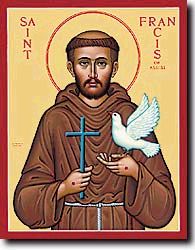
The real Francis of Assisi
Mark Galli at CT:
Full article...
"This saying is carted out whenever someone wants to suggest that Christians talk about the gospel too much, and live the gospel too little. Fair enough—that can be a problem. Much of the rhetorical power of the quotation comes from the assumption that Francis not only said it but lived it.The problem is that he did not say it. Nor did he live it. And those two contra-facts tell us something about the spirit of our age."
Full article...
Subscribe to:
Posts (Atom)