"Elliptic curve cryptography (ECC) is one of the most powerful but least understood types of cryptography in wide use today. An increasing number of websites make extensive use of ECC to secure everything from customers' HTTPS connections to how they pass data between data centers. Fundamentally, it's important for end users to understand the technology behind any security system in order to trust it. To that end, we looked around to find a good, relatively easy-to-understand primer on ECC in order to share with our users. Finding none, we decided to write one ourselves."Full article...
Showing posts with label τέχνη. Show all posts
Showing posts with label τέχνη. Show all posts
Behind the Curve
A beginner-level introduction to elliptic curve cryptography (which is what will be keeping your information safe online for the immediate future). Nick Sullivan:


Web Typography
An excellent introduction to various principles of typography and how they relate to web design. Richard Rutter adapts Robert Bringhurst's The Elements of Typographic Style to a web context. If you do any CSS work at all, you have got to check this out.

Link: webtypography.net ...

Link: webtypography.net ...
That's no moon...
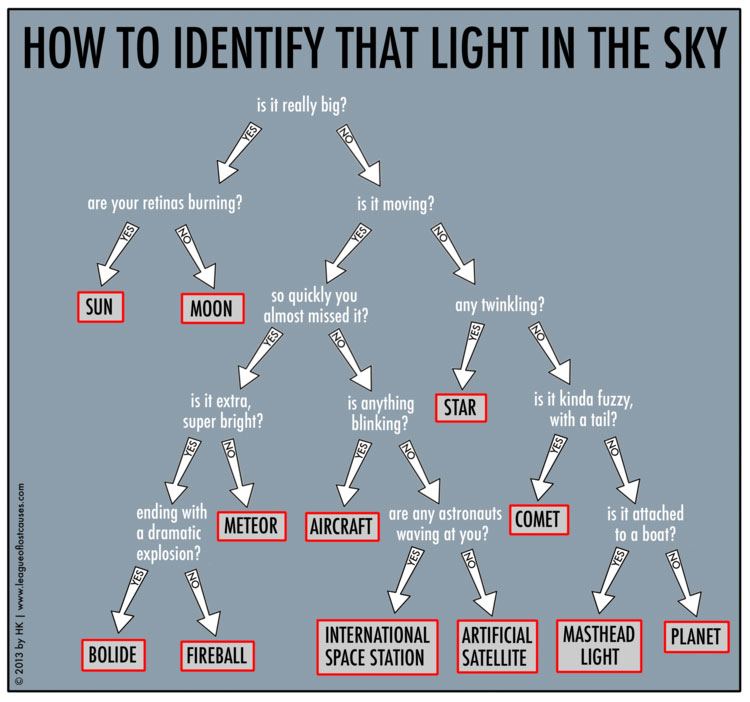
"How to Identify that Light in the Sky", a handy flowchart from NASA:

Source...
ht: Jay Ryan (@JayRyanAstro)
Source...
ht: Jay Ryan (@JayRyanAstro)
Just fix it.
Clive Thompson on the benefits of learning to fix things:
ht:BoingBoing
"There’s also a sort of puzzle-solving pleasure in fixing, a sense of grappling with complexity. You encounter a lot of mystery that you’ll never solve and just have to live with, which is what makes repair a philosophically powerful activity."Full article (make sure to watch the "Kickstopper" video)...
ht:BoingBoing
Now you see it...
From the project's page:
"We propose a method for removing marked dynamic objects from videos captured with a free-moving camera, so long as the objects occlude parts of the scene with a static background."In other words, they can delete people or other moving objects from videos, even if the objects momentarily block other (even moving) objects in the background. Have video evidence of your existence? Too bad: you have been erased. Demo:
For certain values of real...
Here's something that may bother you for a while afterward. First, watch the video below. It purports to be a video of a UFO sighting over California. Decide whether you think the UFO is real or an obvious fake. Once you are sure of your opinion, click here to learn the surprising truth about the video.
[Heads-up for those with kids around: there is 90% of a profanity in the person's reaction at the end of the video.]
[Heads-up for those with kids around: there is 90% of a profanity in the person's reaction at the end of the video.]
What your modem was doing.
Ever wonder what your modem was doing while it was connecting (assuming you are old enough to remember using a modem). Here's a breakdown of what all that noise was about. Reading through this, I can even remember what each part sounded like.
ht:Steve Gibson
 |
| (click image to enlarge) |
Mechanical computers
I was aware that, before electronic computers, they used to use mechanical computers to automate hard math problems, such as fire control for warships. Seeing this set of videos, however, really made me appreciate how unbelievably clever some of these mechanisms were.
A Logic Named Joe
"A Logic Named Joe": a 1950 radio play based on a 1946 short story. It seems to get the basics of the modern-day Internet right, along with playing around with the idea of a technological singularity.
The Wearisome Machine
Just finished reading an interesting short story ("The Machine Stops...") written by E.M. Forster in 1909. Some of what he describes is uncomfortably close to reality today. Here is a link to the full text, and below are some quotes I thought were particularly good:
"Man must be adapted to his surroundings, must he not? In the dawn of the world our weakly must be exposed on Mount Taygetus, in its twilight our strong will suffer euthanasia, that the Machine may progress [...]"~ · ~
"I want to see you not through the Machine," said Kuno. "I want to speak to you not through the wearisome Machine."~ · ~
"[S]he did not notice the noise, for she had been born with it in her ears."
~ · ~
"[She] was seized with the terrors of direct experience."
~ · ~
"What was the good of going to Peking when it was just like Shrewsbury? Why return to Shrewsbury when it would all be like Peking? Men seldom moved their bodies; all unrest was concentrated in the soul."~ · ~
"Rather did they yield to some invincible pressure, which came no one knew whither, and which, when gratified, was succeeded by some new pressure equally invincible. To such a state of affairs it is convenient to give the name of progress."
~ · ~
"[B]ehind all the uproar was silence - the silence which is the voice of the earth and of the generations who have gone."
The Decline Effect
Jonah Lehrer on some problems that scientific studies have been having:
"The decline effect is troubling because it reminds us how difficult it is to prove anything. We like to pretend that our experiments define the truth for us. But that’s often not the case. Just because an idea is true doesn’t mean it can be proved. And just because an idea can be proved doesn’t mean it’s true. When the experiments are done, we still have to choose what to believe."Full article here...
Retweeting the Reformation
The Economist on how there is nothing new under the sun:
"The media environment that Luther had shown himself so adept at managing had much in common with today's online ecosystem of blogs, social networks and discussion threads. It was a decentralised system whose participants took care of distribution, deciding collectively which messages to amplify through sharing and recommendation. Modern media theorists refer to participants in such systems as a 'networked public', rather than an 'audience', since they do more than just consume information. Luther would pass the text of a new pamphlet to a friendly printer (no money changed hands) and then wait for it to ripple through the network of printing centres across Germany. [...] A popular pamphlet would thus spread quickly without its author's involvement. As with 'Likes' and retweets today, the number of reprints serves as an indicator of a given item's popularity."Full article...
Steve Yegge on Services & Platforms
This guy (Steve Yegge) is taking a lot of heat for what he posted (accidentally) about Google, and he has partially retracted it (probably in order to keep his job). It seems to me, though, that what he said is as right as it's legal to be. He takes the side of exposing the maximum amount of information and functionality as services, so that people can decide for themselves how best to use a product, including in ways the makers of the product may not have envisioned.
"But when we take the stance that we know how to design the perfect product for everyone, and believe you me, I hear that a lot, then we're being fools. You can attribute it to arrogance, or naivete, or whatever -- it doesn't matter in the end, because it's foolishness. There IS no perfect product for everyone."Full article (fair warning: he swears somewhat liberally throughout)...
Repair will rise again?
Some hardware hacker called "bunnie" on why the days of repairing computers instead of throwing them away and buying newer ones might be coming back / here to stay:
"There will be a rise in repair culture as technology becomes less disposable and more permanent. Replacing worn out computer parts five years from their purchase date won’t seem so silly when the replacement part has virtually the same specifications and price as the old part. This rise in repair culture will create a demand for schematics and spare parts that in turn facilitates the growth of open ecosystems and small businesses."Link to full article (with charts and graphs!)...
Quote #148
"The cyber-revolution has made it possible for us to deceive ourselves about how close we are [...]"
— Douglas Wilson
Siding w/ Vinyl
Just saw this quote in an Amazon.com review: "Vinyl is the future of physically packaged music." Funny thing is, I think I agree. (I'm currently in the process of buying a record player. Otherwise, I'm all digital for audio.)

Getting Old
Daniel Wilson writes at The Wall Street Journal:
ht: Mockingbird
At some point, you probably stopped to wonder where all the pay phones had gone. You've been heard to say, "May I speak to a human, please?" Perhaps you've even contemplated the deeper questions, like just what in the hell does Twitter do? We think we're afraid of the technology. But we're really afraid of getting old.Full article...
ht: Mockingbird
A.I. Singularity
Time:
[...] But Kurzweil would spend much of the rest of his career working out what his demonstration meant. Creating a work of art is one of those activities we reserve for humans and humans only. It's an act of self-expression; you're not supposed to be able to do it if you don't have a self. To see creativity, the exclusive domain of humans, usurped by a computer built by a 17-year-old is to watch a line blur that cannot be unblurred, the line between organic intelligence and artificial intelligence.Full article...
Subscribe to:
Posts (Atom)